

When Corporate Story Meets Media Context: Behind the Scenes of the Non-Profit Search Engine “Ecosia” Landing a Feature in Forbes JAPAN
“Ecosia“, the world’s largest non-profit search engine. Their founding story and the episode of the “ping-pong table” cherished in their office graced the pages of Forbes JAPAN (May 25, 2026 issue).
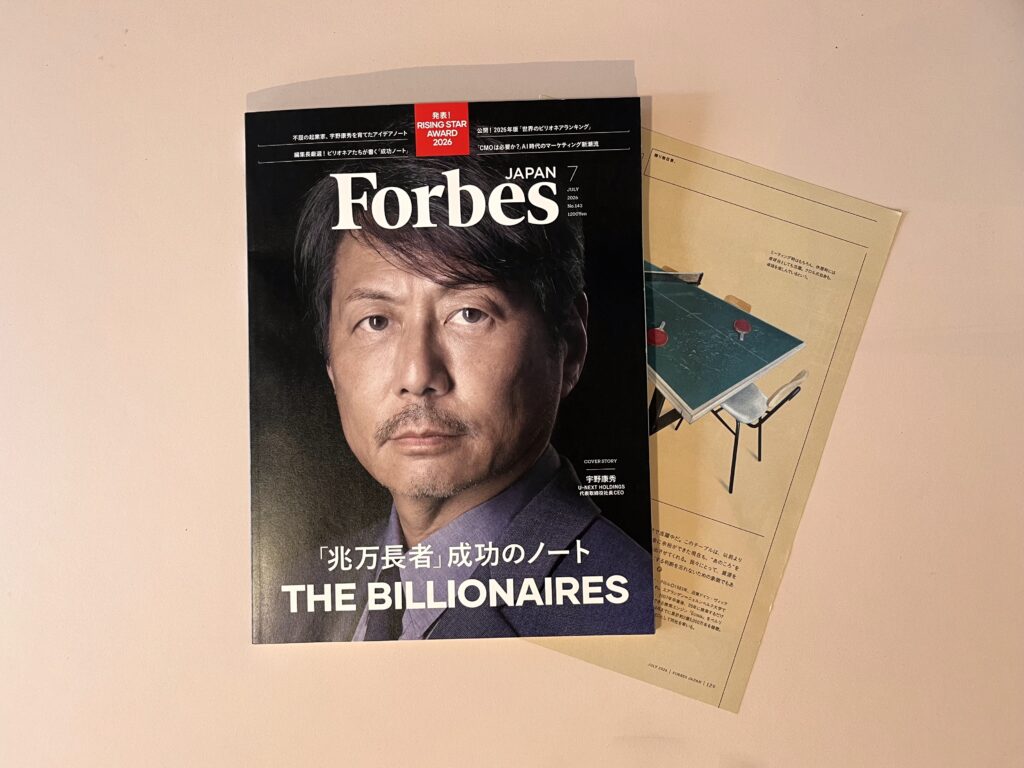
Introduced alongside a beautiful illustration, this article has resonated with many business leaders who read it. However, this excellent exposure wasn’t simply born from “distributing a press release.” It was realized precisely because strong branding and a meticulously calculated message strategy aligned with the media’s needs.
Today, from the perspective of WONDERHOODS, who served as Ecosia’s communication partner, we will discuss the behind-the-scenes of “good exposure” born when corporate stories overlap with appropriate media relations, and the state of PR in modern Japan.
The Drastically Changing Japanese Media Landscape and the Obsolescence of “Traditional PR”
In recent years, the media environment in Japan has continued to change dramatically.
Pre-COVID, “legwork PR”—visiting media editorial departments directly or building relationships with reporters over lunch—was common. Now, however, main phone lines for many editorial desks have automated responses, and methods for direct relationship-building have changed significantly.
Even more serious is the “chronic talent shortage” striking the media industry. It is not uncommon for media outlets to have only one dedicated editor, with the rest balancing dual roles or working freelance. Even the once-glorified “Global CEO visits to Japan interviews” are increasingly being passed on due to a lack of media resources (an inability to allocate time for interviewing and writing).
Under these circumstances, the traditional approach of PR agencies “blindly sending out releases” or “one-sidedly pitching interviews” to the media is no longer effective. To establish a company’s branding in the Japanese market, rather than pushing out home-country materials as-is, it is essential to translate them into a message strategy aligned with Japanese business and social issues, highly packaging them as “information that readers demand right now.”
“Re-editing” over “Translating”: WONDERHOODS’ Message Strategy
A common mistake in the Japanese expansion and PR of foreign companies is “directly translating globally successful strengths and service materials into Japanese and distributing them to the media.” However, to build consistent branding in Japan, which has a different culture and market background, literal translation of words is insufficient.
At WONDERHOODS, we do not simply translate languages. What we focus on is deeply deciphering the Japanese market and industry issues, and “re-editing information” to elevate it into a uniquely Japanese message strategy.
If necessary, we interview Japanese sales representatives and key personnel on the ground to extract the actual pain points faced by Japanese customers and the “living words” used in the field. We localize the client’s global strengths to match the perspective of Japanese readers and reporters, reconstructing them into a message strategy that deeply pierces the target audience before disseminating them.
Our Collaboration with Ecosia: Branding that Articulates Philosophy
The case of Ecosia, whom we supported as a communication partner, was exactly a case where this unique message strategy bore fruit.
Timed crucially with Japanese legal revisions, they chose WONDERHOODS as their partner to accelerate their branding in Japan. (The review from the Ecosia representative to WONDERHOODS is published on our Clutch profile page. )
We didn’t just distribute their wonderful information as a release; we worked closely with Ecosia’s Global Communications Lead. Based on their powerful branding of “The Earth as our only shareholder,” we thoroughly explored “what the Japanese media wants to cover now” and “what angles link to social issues.” We worked hand-in-hand to shape an unwavering message strategy.
As a result, this first led to securing a major interview in a top-tier domestic business media outlet.
The Ripple Effect: A Feature in Forbes JAPAN Magazine
And it was a Forbes JAPAN editor who saw this dissemination based on a consistent message strategy. This led directly to an interview offer and the wonderful main magazine feature: “The Founding Story and the Ping-Pong Table.”
This chain of successes is not merely an accumulation of exposure, but proof that Ecosia’s branding correctly penetrated the Japanese media, and we believe it is the result of three combined forces:
- The Power of the Media (Editors): A professional perspective that always puts readers first and seeks valuable stories.
- The Power of the Client (Ecosia): An outstanding service that puts the global environment first, and an unwavering founding philosophy (the core of branding).
- The Power of the Agency (WONDERHOODS): The editorial ability and relations to appropriately connect those two parties with a message strategy aligned with Japanese social issues and business contexts.
PR Agencies are “Behind-the-Scenes Supporters” Translating Passion
This year again, WONDERHOODS has secured numerous placements in top-tier domestic media such as the Nikkei and Yahoo! News. None of these are mere luck; they are the result of steadily executing “message strategy construction” and “continuous branding support” centered around the client’s business and social issues.
A PR agency is, after all, merely a “behind-the-scenes supporter,” not the main star in the spotlight.
However, converting a client’s passionate thoughts and wonderful services into “messages that reach” and benefit both Japanese readers and the media, thereby contributing to corporate branding—we believe that is our mission and our greatest value.
If your company has a story that needs to be shared with the world, please consult WONDERHOODS. We will optimally translate your business and branding into the Japanese context and deliver them to their rightful place.